India's energy consumption is increasing and it is likely to grow for quite some time as efforts to
provide better living standards to her population are made. Thus, during the last decade, India's
energy consumption more than doubled from 91 million tonnes of oil equivalent (mtoe) in
1980-81 to 189 mtoe in 1991, reaching 219 mtoe in 1994-95. Most of the increased energy
consumption has been contributed by coal and oil, the fuels that are also associated with
emissions of greenhouse (GHG) gases. As a signatory to the Framework Convention on Climate
Change that was adopted at Rio by the international community, India needs to pursue
environmentally sound energy development. Since fossil fuel use contributes the largest share of
GHG emissions in the atmosphere, efficient production and use of energy can reduce emissions
and put India on a low energy intensive growth path, and thus benefit the environment most in
the long term. Equally of concern are the health effects associated with fossil fuel use, and soil
and water pollution due to coal based power plants. Thus, one of the best ways to improve
quality of life and reduce environmental damage is also by increasing energy efficiency.
Coal is a major source of energy in India, providing more than 60% of the commercial energy
requirements. Coal is also most polluting fuel in terms of GHG emissions. Considering India's
energy resources, coal may continue to provide a large part of energy requirements in the future
too. Coal is mainly used for generating electricity. Therefore, efficient measures for generation,
transmission and end use of electricity can help in reducing the environmental pollution, leading
to environmentally sound development. The report highlights some such important measures;
reduction in auxiliary consumption (ie. the electricity consumed by generating units in the
process of generation), reduction in transmission and distribution losses, and application of
demand side management (DSM) options for high tension industries. A glance at India's power
sector indicates considerable scope for improvement in these areas; auxiliary consumption in
various thermal power stations in the country varied between 8 to 14% in 1994-95, transmission
and distribution losses between 16.4 and 25.5% in major power consuming states (with an
average of 21% at all-India level). DSM options, that have already made impact in some of the
developed countries, are yet to make a headway in India.
The study was conducted in two phases. Maharashtra State Electricity Board (MSEB), the largest
utility in Maharashtra was chosen for the detailed study in the first phase. For the study of
auxiliary consumption, two typical plants of the MSEB were selected. The transmission losses
were studied for the MSEB system based on a snap-shot picture of the system. For the DSM part,
energy saving potential in HT industries in Maharashtra was explored based on a survey of HT
industries.
In the second phase of the study, two more plants outside Maharashtra were also studied to get better insight into diverse causes for the different levels of auxiliary consumption and estimate potential savings. All India potential for savings through reduction in auxiliary consumption was also estimated in this phase.
Auxiliary consumption
The consumption of electricity by power plant auxiliaries depends on factors such as unit size,
level of technology, plant load factor, coal quality etc. The largest share of installed capacity in
India (about 48% in 1995, accounting for 25,600 MW approx.) was from 200/210 MW units,
most of which were installed in the late seventies, and eighties. The auxiliary consumption in
these plants varied between 8 to 14%. A majority of these plants are yet not due for renovation,
but available technology for power plant auxiliaries has considerably improved since their
installation, indicating substantial scope for reduction in power consumption in these plants
through up-gradation of auxiliaries. The case study was therefore focused on 210 MW power
plants.
Auxiliary equipment upgradation: High auxiliary consumption in power plants can be due to the
factors outside control of an individual plant; for example, coal shortages and poor coal quality,
grid requirements (backing down, reactive generation requirements) etc. However, there are
several technological and other plant related factors that can be addressed to reduce auxiliary
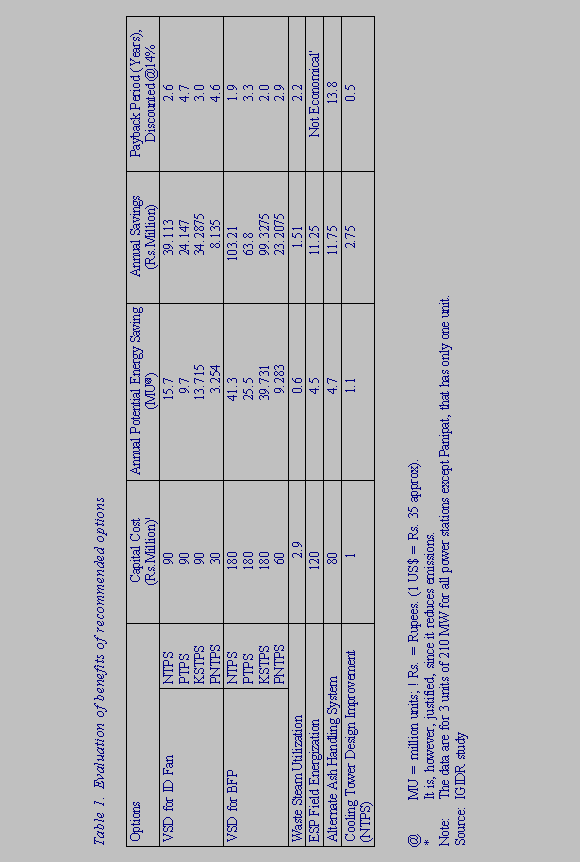
consumption. Replacement of existing drives for ID fans and BFPs by variable speed drives,
utilization of flash steam from continuous blow down and waste steam LSHS tank heating to
provide air conditioning in the plant through vapour absorption system, cooling tower system
improvements (for example, through a system to apply 24 volts on motor windings to prevent
ingress of moisture in Nasik TPS), retrofit for ash handling system, and pulse energization of
ESPs were evaluated for the case study plants. Overall energy and CO2 savings, payback periods
and cost of CO2 reductions from various options are given in Tables 1 and 2. The reduction in
auxiliary consumption as a percentage of electricity generation for these units is between 1.53%
and 2.2%, respectively. If an average auxiliary consumption reduction of 19 million units (MU)
is considered for 80 units of 210 MW (about 70% of the total 120 units), energy savings work out
to 1520 MU and CO2 emissions savings are approximately 1.5 million tonnes per annum.
Other measures: Improvement in the power factor of auxiliaries, proper sizing of auxiliaries, and
measures such as sliding pressure operation of units (as against BFP discharge throttling to keep
turbine inlet pressure constant), instrumentation for auto air-load control to run the unit with
optimum excess air, reliable flame monitors etc. can be selectively studied for individual power
plants. Coal beneficiation to improve coal quality and turbine uprating (from 210 MW to 235
MW, already a proven upgradation technique) are other promising alternatives that offer
quantum jump in efficiency of power production.
All-India level energy savings: NATGRID model developed at IGIDR was used to quantify
possible cost savings resulting from energy savings through reduction in auxiliary consumption
at all-India level. The model considered 19 electric utilities with 210 generating units, 90
inter-utility transmission lines, 23 major coal-fields and 97 power station to coal-field linkages to
minimise the total system cost. The results are given in Table 3.
The CO2 emission savings range from 0.7 million tons to 1.5 million tons per year. Since decrease in unmet demand in this exercise also comes from reduction in auxiliary consumption, same has also been considered while calculating savings. Over the life time of the power plants, the savings could be as large as 23 million tonnes.
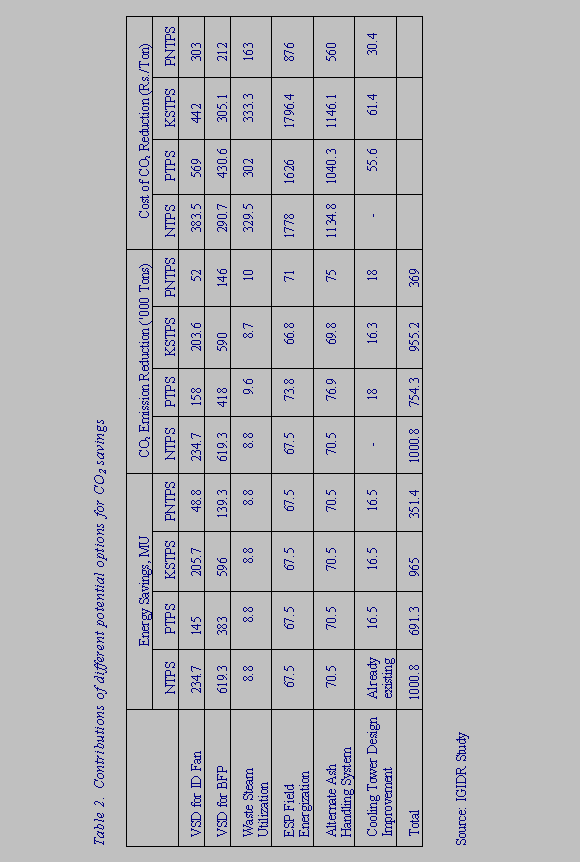
Table 3. Reduction of auxiliary consumption considering national grid operation
| Parameters | Auxiliary Consumption | ||
| Actual | Restricted 10% | Restricted 8% | |
| Total System Operating Cost (Million Rs.)
Unmet Energy (MU) Total Generation (MU) Total Auxiliary Consumption (MU) Coal Based Generation (MU) Total Coal Supplied ('000 Tons) Average Generation Cost (Rs./kWh) Average Thermal Units Auxiliary Consumption (%) Annual CO2 Reduction ('000 Tons) Rate of Emission (Tons/kWh) |
46,215
15,811 45,757 3,246 30,104 22,101 1.01 10.8 - 0.7239 |
45,101
15,010 45,788 3,017 30,095 22,095 0.985 10.02 589 0.723 |
45,188
14,352 46,778 2,586 29,906 21,965 0.966 8.6 1239 0.70 |
Source: IGIDR Study
Reduction in transmission and distribution losses
Transmission and distribution (T&D) losses of major states in India varied from 16.4% to 25.8%
in 1992-93 with an all-India average of 21.8%. Although losses in developed countries are very
low compared to this, considering its special characteristics, expert committees have suggested
an upper limit of 15.5% for Indian power system. MSEB system is relatively efficient with losses
at 16.4%, but losses have varied from a low of 14.3% in 1987-88 to 18.3% in 1990-91. A break
up of the typical losses in MSEB system indicated that although transmission losses are within
the prescribed norms, distribution losses are higher. The T&D losses can be technical losses such
as transformer and feeder losses and non-technical losses (also known as commercial losses), that
are mainly due to pilferage and faulty meters.
Distribution system study requires a field study to measure losses at different locations in the
network. An experimental study was outside the scope of present study. However, a MSEB study
indicated overloading of 8000 distribution transformers in the system and a high reactive load
(with power factor as low as 0.6) resulting in high losses. The measures initiated by MSEB to
reduce losses include provision of additional transformers in case of overloaded areas,
requirement of capacitors for LT consumers at their premises, leasing scheme for LT capacitors
for transformers for agricultural consumers, and upgrading transmission voltage, wherever
possible. Steps have also been initiated to check commercial losses. There are several measures
that can be taken to reduce distribution losses depending on the causes that are identified based
on a field experiment. Short term measures include reconductoring, installation of capacitors,
reconfiguration of the network, upgradation to high voltage transmission etc. In the long term,
system can be optimized through a detailed system study.
Transmission losses in the high voltage network were studied for the MSEB system based on a
snapshot picture of a typical peak hour. The analysis indicated scope for improvement in losses
even for HT transmission. At some buses in the system, reactive power compensation was
observed to be inadequate resulting in voltage drop (and hence losses). Thus, increased reactive
compensation can reduce transmission losses further. The results are summarised in Table 4.
Table 4. MSEB HT transmission system losses
| Type of Bus | Actual Voltage Range | Power Factor | Remarks |
| 400 kV | 378 kV - 401 kV | - | Out of 9 buses, 3 had none and 2 had inadequate compensation. |
| 220 kV | 211 kV - 225 kV | 0.77 - 0.79 | Seven buses were with PF and voltage in this range. In addition to this, two buses were with low voltage, 206 and 204 KV. |
| 132 kV | 121 kV - 123 kV | 0.79 - 0.81 | Eight buses were with PF and voltage in this range. In addition, three buses had low voltage, 121 to 122 KV. |
| 100 kV | 96 kV - 99 kV | 0.69 - 0.78 | There were four buses with PF in this range. |
Demand side management (DSM) options
The DSM study is based on an earlier comprehensive study carried out at IGIDR, that included a
survey of HT industries. DSM offers several advantages such as reduction in electricity
generation requirements on account of energy savings, short gestation period of 1 to 2 years for
DSM measures as against 4 years and more for power plants, reduced burden on infrastructure
such as transport (as a result of reduced fuel requirements) etc.
The HT industries in Maharashtra consumed 31% of the electricity in 1992-93 and accounted for
38% of peak demand. Motors, melting, electrical heating, compressed air, air conditioning and
lighting were major end-users of electricity. DSM options considered were energy efficient
motors, variable speed drives, good house keeping practices, vapour absorption refrigeration
systems (VARs), improved electric arc furnaces (EAFs), efficient lighting systems (replacement
of 250 W high pressure mercury vapour lamps by 150 W high pressure sodium vapour lamps,
replacement of Incandescent by Compact Fluorescent Lamps (CFLs), and replacement of
magnetic ballasts by electronic ballasts), high efficiency fans and pumps, improvement in power
factor (PF), industrial Cogeneration (COGEN), and time of day tariff (TOD). These options were
evaluated using COMPASS software. The payback period for these options varied between 0.5 to
2.4 years with an active DSM programme, and between 0.6 to 4 years without a DSM
programme. DSM programme is required to accelerate rate of adoption and diffusion since
typical consumer discount rates to evaluate an option are very high; 25% and above as against
utility discount rate of 14%. A five year DSM plan (1994-98) was worked out (Table 5). It can be
seen from Table 5 that with all the identified options, demand savings of 760 MW and energy
savings of 8590 million units are possible in a five year period. The cost of saved demand for the
utility is Rs. 4500/kW, and overall cost (including DSM participants costs) is Rs. 15900/kW. The
peak demand is expected to flatten gradually by the above order over a five year period.
Table 5. Five-year DSM plan for Maharashtra - summary of results
| DSM Option | Demand
Savings
(MW) |
Energy
Savings
in 1998 (MU) |
Programme
cost (Rs. million) |
Utility
Rs/kW |
CSE
Rs/kWh |
Rs/kWh
Total resource |
| TOD
EAF CFL GHK HPSV EEM VSD VARS ELB PUMPFAN PF |
160
26 1.5 80 1.6 14.3 54.1 16.2 3.5 23.3 58.2 |
-
356 17.8 906.4 29.1 169.3 1260.7 301.3 35.7 304.4 0 |
376
69 4.5 415 13 189 196 219 63 278 78.1 |
1700
2000 2900 3800 6500 9000 10200 10600 12400 8500 800 |
-
0.20 0.61 0.86 -0.1 0.63 1.05 0.64 1.00 0.77 |
2100
7500 6300 11900 9700 17600 41100 28000 24300 28000 3200 |
| Total | 436.7 | 3380.7 | 1900.6 | 4300 | 0.82 | 12700 |
| COGEN | 323 | 5211.6 | 2328 | 4800 | 0.76 | 19100 |
| Grand Total | 759.7 | 8592.3 | 4228.6 | 4500 | 0.78 | 15900 |
The impact on environment is through reduced emissions of CO2, and other local pollutants like
SO2 and NOx. More than 9 million tonnes of CO2 and 27 and 43 thousands of SO2 and NO2
respectively is expected to be emitted less over the five year period.
Barriers in implementations
Institutional barriers: Currently, there is no institutional mechanism in the utilities to
systematically take up issues related to upgradation of equipment in power plants, T&D lines,
and DSM formulation and implementation. The thrust of the current set up in the utility is on
expansion rather than consolidation and modernization of existing stock. As a result, returns are
poor from the existing plant and equipment. Due to lack of an institutional set up, other barriers
such as technical, communicational also exist that hamper implementation of upgradation
programmes in these areas. Technological barrier may also exist due to lack of exposure and
training of the plant personnel.
Institutional set-ups are therefore needed at plant and overall utility level to take up upgradation
programmes in these areas. Outside experts can be associated with such set-ups (for example
from consulting firms, power plant manufacturers, universities etc.) to synergise the expertise. In
case of DSM, innovative approaches such as energy service companies (ESCOs), consortium
approach (consisting of utility, industry associations, financial organisations and relevant
governmental agencies) need to be explored.
Financial barriers: Currently, there is no appropriate financial mechanism to carry out
upgradation programmes, except for complete plant renovation. Therefore, even if upgradation
plans were to be systematically formulated, non-availability of funds may be a problem. One of
the major reason for this is current pricing policies for the power, that make the utilities
financially dependent on government. Further, the current policies are neither conducive to
conservation nor to build up a healthy power sector that may be capable of raising its financial
requirements. DSM programmes need explicit funding mechanism that also does not exist.
Besides a funding mechanism, launching of DSM programmes would first require a
demonstration through a pilot project. However, the pilot project can be funded by some of the
existing energy funding programmes of IDBI and ICICI.
Restructuring and reforming power sector policies is vital to success of conservation
programmes. International agencies such as World Bank, ADB, GEF etc. can also be approached
for relevant programmes in these areas. ESCOs can become viable with sound power pricing
policies, and raise money from the market.
Recommendations for future work and role of various agencies
Based on the foregoing discussion on the barriers to DSM and the institutional and financial
mechanisms needed to overcome them, following steps have been identified for the next phase of
work.
(i) Action by MSEB
(a) Formation of an expert group in MSEB at the apex level (in the corporate office/planning
department), responsible for drawing up short term and long term measures for technological
upgradation for plants and T&D lines, and conservation programmes including DSM. Experts
need to be drawn from various plants and T&D zones/stations and outside organizations. For
example, depending on area of expertise, experts from other utilities, NTPC, manufacturing
organizations like BHEL, other industries, institutes/universities, and governmental agencies like
EMC can be associated with the group.
(b) Formation of a task force in each plant and T&D zone to formulate and execute the plan for
the plant or T&D zone/station, based on the recommendations of the expert group.
(c) Formation of a consortium consisting of representatives from MSEB, industry (equipment
manufacturers), associations like CII, governmental agencies (like EMC) and a research
institute/university working in this area, to initiate a pilot project for DSM.
(d) Commissioning a study on reforms required in pricing policies and interacting with the state
government for carrying out the reforms.
(ii) Action by the State Government
(a) Providing the necessary information, policy guidelines and support for working out the
pricing reforms by MSEB.
(b) Assistance in getting the recommended pricing reforms implemented, if necessary through
legislation.
(c) Taking up issues, whenever required, with the central government to implement the
recommended pricing reforms.
(d) Introduction of more autonomy and accountability through an MOU with the MSEB and if
necessary, initiating steps to convert the board into a company for this purpose.
These measures are expected to not only tap the conservation potential that this study indicates,
but go a long way in improving the overall working of the utility.