
No. 9 May 1997 Supplement
|
No. 9 May 1997 Supplement |
The Newsletter of the UNEP Collaborating Centre on Energy and Environment

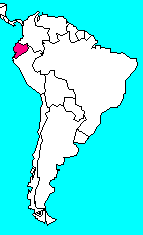 The environmental
agenda in Ecuador has been dominated by concern for the declining forest cover,
destruction of mangroves and land degradation. However, few activities have provoked such
serious extensive environmental damage in Ecuador as petroleum exploration and
exploitation, which began in Ecuador's Amazonian region in 1970. Direct impacts deal with
the pollution of watercourses by crude oil and formation of water spillage, soil erosion
and pollution by indiscriminate building of roads paved with oil wastes. Some of the most
evident indirect effects include deforestation and destruction of biodiversity in large
areas; native peoples affected by the alteration of their habitat, their culture and the
introduction of diseases; and economic and social marginalisation of native peoples and
settlers.
The environmental
agenda in Ecuador has been dominated by concern for the declining forest cover,
destruction of mangroves and land degradation. However, few activities have provoked such
serious extensive environmental damage in Ecuador as petroleum exploration and
exploitation, which began in Ecuador's Amazonian region in 1970. Direct impacts deal with
the pollution of watercourses by crude oil and formation of water spillage, soil erosion
and pollution by indiscriminate building of roads paved with oil wastes. Some of the most
evident indirect effects include deforestation and destruction of biodiversity in large
areas; native peoples affected by the alteration of their habitat, their culture and the
introduction of diseases; and economic and social marginalisation of native peoples and
settlers.
Within that context, climate change mitigation actions should be understood as an essential component of a complex and interlinked set of strategies and policies aimed ultimately at fostering a sustainable development path. Options such as improved operations and maintenance in the oil industry, gas pipeline leak reduction, reduced flaring, landuse policies, and in general efficiency improvements in energy production and use have significant impacts not only as measures for controlling GHG emissions but also as urgent actions for mitigating environmental deterioration in the country.
Ecuador has been conducting a climate change country study with support from the USA Country Study Programme. The study, conducted by the Meteorological Institute, as the lead agency, was initiated in May 1994 and is at the completion stage. While the national GHG inventory has been completed following the IPCC guidelines, climate change mitigation and vulnerability analyses have only been covered in broad terms. The ongoing mitigation study undertaken under the UNEP GEF project will asses potential mitigation options in depth, integrate them into a comprehensive analytical framework, evaluate economic and social impacts, and provide government institutions with necessary elements for a national climate change mitigation strategy.
A working team, including relevant institutions under the coordination of the National Advisory Commission for the Environment, has been appointed for supporting the study, which is conducted by the Ecuadorian Foundation for Energy and Environment. The Stockholm Environment Institute Boston Center and the Institute for Energy Economics are providing technical support to the national team.
A national workshop took place on 1011 April 1997.
Project Coordinator: Carlos Quevedo, Ecuadorian Foundation for Energy and Environment.
UNEP Centre Project Manager: Arturo Villavicencio
| index for this issue | c2e2 main index |
| Last updated: 30 July 1997 | goma@dtu.dk | |
| UNEP Centre | Systems Analysis Department | Risų |